Category Archives: Features

Why learn to sail in Cornwall?

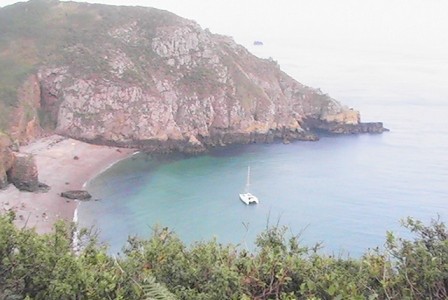
mago-anchored-scilly

Mago Merlino. Anchored. The Isles of Scilly

All you Brits out there know that if you sail you’re in the Solent. Well I got sick of sailing in the backdrop of oil refineries and power stations years ago.

MINOLTA DIGITAL CAMERA

Polkerris. We’ve nipped ashore to the pub. Catamaran style! learn to sail in Cornwall

Now Cornwall and the beautiful, unspoiled waters of the Southwest is  another place entirely. Here we can visit tiny, magical harbours like Polperro, Fowey, Mevagissey and Polkerris and we also have huge areas of sheltered unspoiled waters like the estuaries of Falmouth and Plymouth. Nestling within easy reach are Helford and of course the River Yealm. Further a field, but still within reach (weather permitting) are the Isles of Scilly and Guernsey, Herm and Sark.

MINOLTA DIGITAL CAMERA

Tremayne Quay. Helford River


dixcart bay

Anchored off Sark, Channel Islands

My annual adventures go to Brittany, Scotland and Norway! Yes I run Day skip courses like all the rest, but with us you can also live the REAL cruising life. Warts an all.

Tack a Catamaran. Simple enough you might think?

Learn to tack a catamaran.

Catamarans do not point well when heading to windward. A decent performing mono-hull will point at 40 degrees or better. A cat will be doing well if she can sail at 45 degrees apparent. Cats sail faster so the apparent wind is always further ahead. Therefore they can’t point high when close hauled. true wind when close hauled will be 50 or worse!

We are sailing at 45 degrees to the wind when we are close hauled. ( 50 true) So when we tack a catamaran we go through at least 100 degrees. What does this matter?

Well it means that we have to “free wheel” with no drive from the sails for longer and further than a single hulled vessel.  Not good.

Catamarans have no ballast. That’s great as they don’t sink! but if you take the drive off they stop! Waves carry massive inertia and when they hit us we have nothing much to fight back with. So again we stop.

  • PICK YOUR MOMENT. Watch the sea and go into the tack on top of a wave, not climbing a big face.
  • SPEED is essential. We have a long way to go around until we can fill the sails to gain drive on the new tack.

If its a rough day and the waves are slowing us down then bear away a little more and really get the boat moving. She won’t go around otherwise.

  • GET THE WHEEL OVER. Don’t mess about turning slowly (as you would on a Mono-hull to give the crew time to get the foresail over). Even if you turn as fast as she can, the crew will still have plenty of time. However if you turn slowly you loose SPEED and you won’t make it all the way through the wind.
  • GO AROUND FAR ENOUGH. If you are used to sailing half a boat! (Mono-hull) You will not tack through enough angle and she will end up “in Irons”.

Most Multihulls these days have massive mains’ls, which act like church roof weather vanes . (They make the bow point into the wind) So with the heads’l empty she will stay head up in the wind. So lets go around far enough and even dump the main sheet if necessary to allow her to bare away.

  • THIS ISN’T A DINGHY. ” Ready about” “Lee ho!”
    NO! DON’T LET FLY THE JIB SHEET. She’s going to take a while to get into the wind. Watch the Foresail and let the sheet off when it empties. You should not need to “back” the jib however. Make sure you have no snags on the sheet.

As the boat turns into the wind the apparent wind increases. This makes it come from further aft. Use this to keep the drive on.

That doesn’t make sense does it? Its true however.

The boat is for example sailing at 8 knots. In an apparent wind speed of say 12 knots. As you turn into the tack, the wind speed increases to 14. ( you are turning straight towards it so the vector is changing)

Try it! Get close hauled and sailing well. Luff up slightly and you’ll see the jib tell tails on the windward side become unstable. Note the course.

Now get her up to speed again. Then throw the wheel over to tack and watch the jib tell tails again? Yes they stay stable far longer than they did in the first example! We can sail the jib into the tack to keep the drive on for longer.

  • TIMING IS EVERYTHING. As in all things really. Preparation, good sail trim, Speed, communication, all essential.

Some say cats wont tack. So careful what you buy!
I can tack a cat out of a “hove to” position ( yes every time!) That’s right, I have no boat speed! Cats can be ballet dancers under sail, but “not a lot of people know that”. Try a catamaran course with us and I’ll show you!

Why learn to sail on a Catamaran?

Catamaran at sea

Well they’re…

“Twice” as stable?

Cats stay flat. Cruising Catamarans don’t heel so they make very stable learning platforms, unlike monohulls, where you live at 30 degrees. Imagine trying to learn to sail, navigate or even sleep at that angle!! Seriously, its hard to take your first steps navigating ( and fighting off the old seasickness) when you can’t see the horizon from the chart table. On a Catamaran you simply step into the saloon and there’s the chart table and a window so you can see the horizon.

“Twice” as safe?

All that stability means you’re not being constantly thrown about risking injury. A cockpit twice the size of most other sailing school boats, means everyone can learn to sail safely without tripping over each other. Two completely separate engines give us ultimate safety should one break down.

Safety is not just about “will it tip over?” I’ve been sailing these boats in all weathers for 20 years and I’VE NEVER COME CLOSE.

However I have made a lot of mistakes in the past due to tiredness. On catamarans you can sleep at sea without being thrown over the leecloth!

“Twice” as Manoeuvrable!

With those twin engines,  Catamarans are a joy in a tight spot. Some cats have single drives but you can steer the propeller ( Like an outboard on a RIB) There’s a skill to be learned as with anything else, but once you have it . They’re easy!

“Twice” as comfortable!

Why suffer cramp in the damp, when with us you can have a spacious living area, separate galley, hot shower and even proper central heating. Yes radiators!

At home you sleep in a rectangular bed and its flat. Why would you want to sleep in a triangular one at sea at an angle of 20 degrees?

“Twice” the fun!

When it comes to sailing, flat doesn’t mean boring.  Sailing Catamarans are quick! My favourite sport? OVERTAKING!

“Twice” as versatile!

Unrestricted by deep keels, Catamarans can go where they please – To the head of beautiful Cornish rivers, or parking on the beach for a Barby.

Shallow draft of about a metre opens up a huge range of venues denied you if you draw more and of course we dry out flat. Just step off and walk to the pub

All that said, catamarans like all boats, have their bad points and it is our job to point these out as well. See cat familiarisation course